
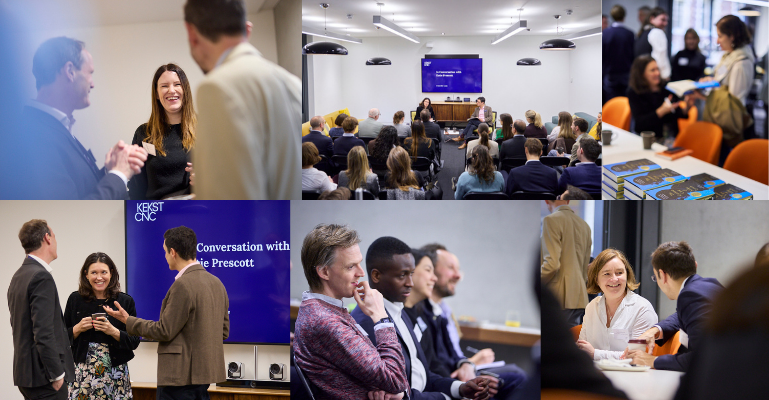
We were delighted to welcome The Times’ Katie Prescott to our London office for a Future Newsroom breakfast discussion, exploring the forces shaping today’s tech and business landscape.
The conversation began with reflections on Katie’s recently published book, "The Curious Case of Mike Lynch", before widening out to the narratives, pressures, and contradictions defining the sector in 2026. What emerged was a sharp, candid discussion on how technology is built, funded, scrutinised — and communicated.
For those who couldn’t join us, here are some of the key takeaways.
Storytelling still shapes tech success
Katie highlighted that in technology, narrative often matters as much as capability. Mike Lynch’s career illustrates how ambition, improbability, and confidence can shape perception just as powerfully as product. She also pointed to Sam Altman’s emergence as a public‑facing tech leader — combining visibility with credibility in a way few founders manage.
At the same time, she noted a growing frustration: as tech leaders become more tightly media‑trained, genuinely original, editorially interesting insights are increasingly hard to find.
Digital sovereignty is moving up the agenda
The discussion touched on rising political and commercial concern around digital sovereignty, particularly dependence on foreign cloud providers. While the UK has historically struggled to scale global tech champions without US capital, Katie pointed to renewed momentum among European founders aiming to build and scale closer to home — with sovereignty now acting as a potential accelerant. She noted Arthur Mensch was on the leading edge in positioning French AI business Mistral around the value of continental sovereignty.
A more honest conversation on AI
On artificial intelligence, Katie cautioned that parts of the market are overheating, with real questions around the quality and credibility of many startups. She stressed the importance of transparency — particularly around AI’s impact on jobs — arguing that leaders who openly acknowledge trade‑offs and disruption are ultimately more credible than those who avoid the issue.
What she’s watching next
Looking ahead, Katie highlighted the rapid emergence of AI agents and their real‑world impact across industries, alongside increasing tech investment from the Middle East. As AI fatigue grows, she noted, the bar for what counts as genuinely newsworthy is higher than ever.