
In this edition of Impact Insights:
- Is executive originality an endangered species in the age of AI?
- How a tech CEO turned a haunted Airbnb into a storytelling win
- Is it time to extinguish the “burning platform” metaphor for good?
AI doom-mongers are having a strong quarter. After fears of a coming. ‘SaaSpocalypse’ wiped billions from software valuations, one thing is abundantly clear: investors and consumers are scrutinizing AI with new intensity, right down to the language used to describe it.
Where companies once ran towards anything labeled “value-accretive,” “AI-native,” or “agentic,” a corrective skepticism is setting in (see this The Wall Street Journal piece).
For software and data companies in particular, effective and accurate communication equals value. Anything else is a risk.
At the same time, AI-authored content is creating a what the Financial Times’s Pilita Clark called the “hopelessly persistent patois” of “global business-speak” at Davos.
Executives should take note. When we developed the Executive Impact Score, the sociolinguists we worked with at The University of Oxford identified the originality of a speaker’s language as one of seven key factors that make audiences pay attention.
But originality is easier said than done, as anyone who has found themselves doing a “deep-dive” to “shift the dial” will tell you. Here are three examples of originality in action.
Perfection is forgettable. Humanity wins.
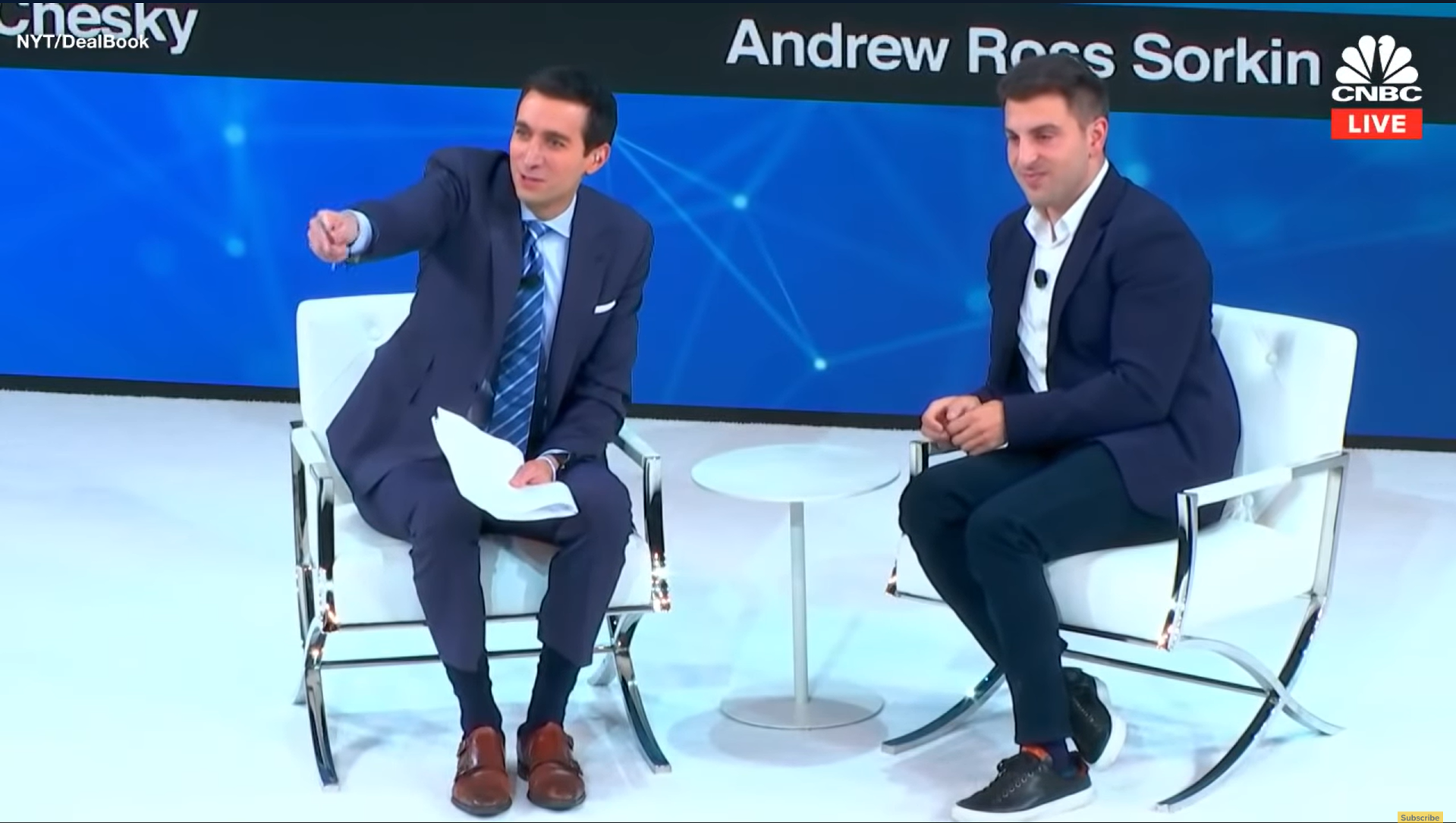
A year before Airbnb went public in 2020, CEO Brian Chesky took to the stage at The New York Times DealBook event, where he doubled down on the company’s commitment to a “new economy built on trust.”
His anecdote of handling a customer complaint involving a supposedly “haunted” rental, complete with a ghost called Stanley (26:30) was a master class in storytelling. Unscripted and on brand, it revealed the human story behind Airbnb’s software – in a way the audience did not expect.
Crucially, Chesky doesn’t sanitize the story. By admitting that things do not always go to plan on a customer-led platform, he gained credibility.
The lesson: when the setting allows, unpolished storytelling that aligns with brand values sticks with audiences and builds trust.
Bridging to the familiar drives connection.
When Canva CEO Melanie Perkins spoke to BBC’s Business Daily podcast, she was asked how education must adapt to the AI era (listen from 06:15).
Her answer began with a neat observation “We’ve gone from the information era to the imagination era.” In one line, she captured the idea that in an AI-powered world, human creativity and curiosity become the differentiators.
Perkins then compared the rise of AI to the arrival of calculators, arguing that it will empower rather than erode creative industries.
The analogy will not persuade every skeptic, but it provides a concrete reference point in an otherwise abstract debate.
It’s a reminder that meeting audiences where they are matters. Starting from familiar ground is often the fastest route to understanding and engagement.
The lesson: read the room to avoid going overboard.
Creativity can also misfire.
In 2011, a widely circulated leaked speech to Nokia employees from CEO Stephen Elop described the company as standing on a “burning platform,” surrounded by “scorching heat,” – a thinly veiled reference to Apple and Android.
The phrase has since become a staple of corporate crisis language. But it comes with risks: the metaphor stuck, and so did the sense of panic.
Elop’s comments described a reality that had existed for years, creating the impression that the warning came too late.
Admittedly, the speech wasn’t intended to be public, and Nokia announced a transformational partnership with Microsoft later that week. But declaring the ship is on fire works best when you can point to the lifeboats.
The lesson: In moments of crisis, plain, practical and solution-oriented language is often the surest way to steady the deck.